

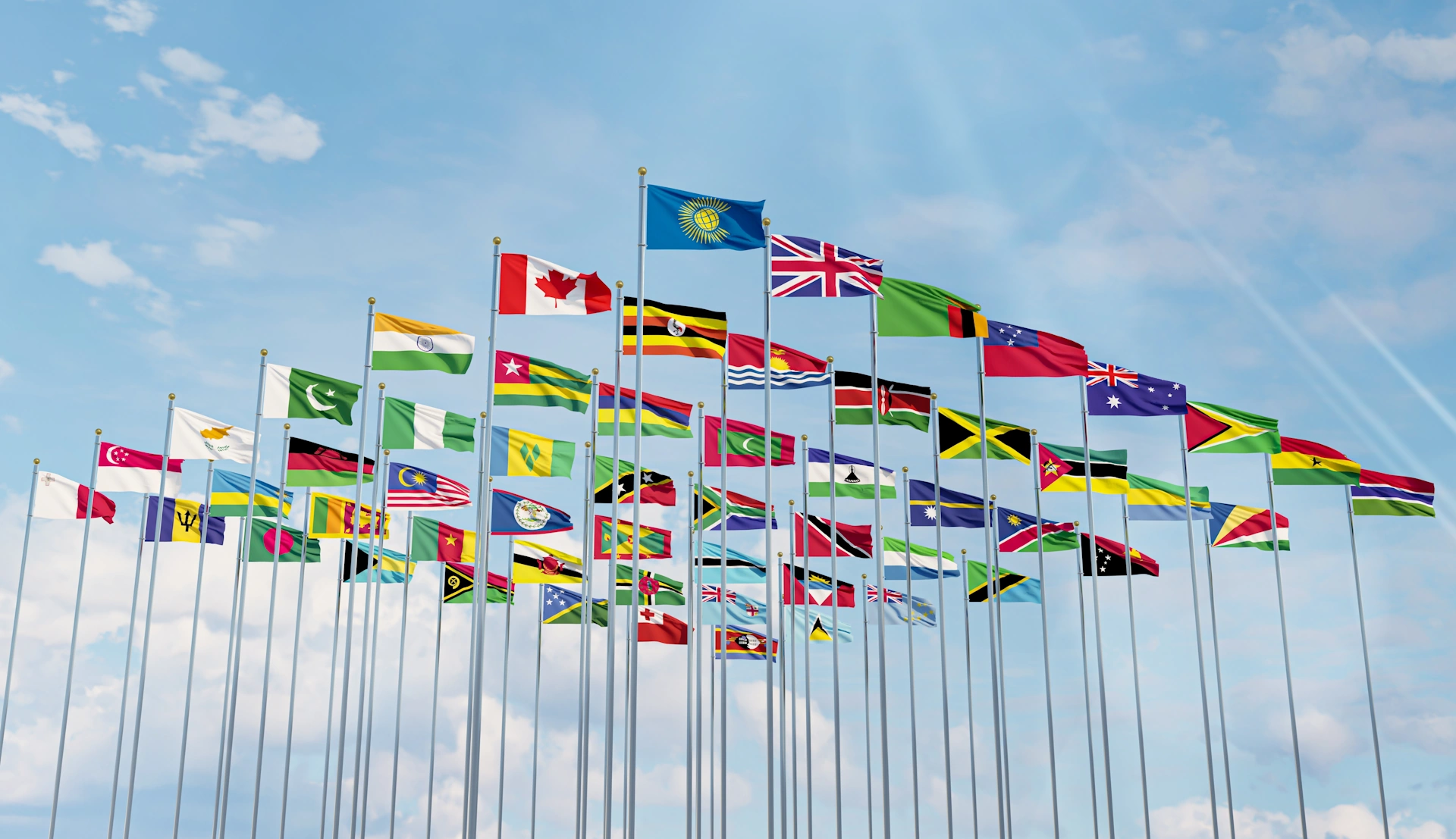
The Commonwealth
Spotlight Report by Michael Rennie
As the Commonwealth Games in Glasgow draw to a close today with spectacular ceremony, it is an opportune moment to turn our attention from achievement in the sporting arena to the prosperity of this unique association of 56 member states.
We are pleased that the Chair of the UK's Commonwealth All-Party Parliamentary Group, Andrew Rosindell MP, and Co-Chair, Lord Kamall of Edmonton, have endorsed the Legatum Prosperity Index, saying:
“It is often easy to think that there are no new stories to be told about global prosperity since we imagine that nations classified as developed countries, such as our own, are unassailable in that status no matter which political party is in power. Elsewhere, other countries — classified as developing or less developed — are assumed to be permanently stuck in, at best, a state of limbo, unable to substantially improve their fortunes.
“The 2026 Legatum Prosperity Index shows just how mistaken this mindset is, and perhaps nowhere more so than in Commonwealth countries. Since the Index's last edition in 2023, the five highest-gaining countries are all Commonwealth nations: Belize (joint highest rise, up 23 places); Trinidad and Tobago (joint highest rise, up 23 places); Sri Lanka (up 10 places); Eswatini (up 5 places); and Uganda (up 5 places). We could particularly highlight The Gambia, which left the Commonwealth in 2013 but returned in 2018, and has thrived since rejoining, climbing 32 places from 139th to 107th since 2015.
“Although none of these countries might be regarded by us as ‘rich’, or classified by the UN as developed, they demonstrate that the stories of national prosperity continue to be rewritten across the world in both directions.”
The driving force behind these countries' improvements lies in multiple areas of the Index, with some countries improving notably in Freedom, and others in Society.
Over the last ten years, Belize's longitudinal rank for Community Trust and Engagement has risen 50 places, moving from 102nd to 52nd. It has gained 74 places in our indicator for ‘Helped a Stranger’, and 46 places in ‘Laughter’, both sourced from the Gallup World Poll. These all point to higher quality interpersonal relationships, a significant driver behind its improvement in the Index.
But compare this to Trinidad and Tobago. The country has made great strides in tackling inflation, where others have failed. From a peak of about 6% in 2022, inflation has since settled to about 0.3%. Over the last decade, we can also see significant improvements in other Freedom metrics. It has moved from 44th to 14th for Freedom of the Press, 57th to 11th for Freedom of Religion, and 49th to 14th for Academic and Cultural Expression. The significant Commonwealth gainers have shown impressive momentum in multiple measures of prosperity.

Compared globally, the Commonwealth also performs very well. The average Freedom rank for Commonwealth countries is eight places higher than the average for the rest of the world. If we break that domain down further into its constituent pillars, the average Commonwealth rank is higher in every single pillar than the rest of the world: two places higher for ‘Civil Peace’, ten places higher for ‘Freedom of Dissent’, and ten places higher for ‘Economic Freedom’. The impressive ten-point leads in the latter two demonstrate a shared Commonwealth understanding that robust public discourse and an easy business environment are central to prosperity.
Elsewhere, in the ‘Society’ domain, Commonwealth countries rank on average five places higher than the rest of the world for ‘Integrity of State’, which measures the extent to which a state controls its territory and can secure the trust of its population.
These higher scores for Freedom and Integrity of State are a testimony to one of the Commonwealth's greatest legacies: the spread of strong civil liberties and governmental and legal institutions. Many share a heritage rooted in the ancient traditions of English common law and Westminster-style parliamentary government. It is a commitment to rule of law and robust public institutions that continues to unite Commonwealth nations as they grow together in prosperity. Indeed, these are pre-requisite commitments for joining.
Looking at the last decade, we can see certain Commonwealth countries have managed to sustain improvements of the longer term too. The Gambia is the most notable example. Having temporarily left the Commonwealth in 2013, the Gambia returned in 2018 and has shown great improvements across the whole decade of our study. Its rise of 32 places since 2015, from 139th to 107th, makes it the second largest gainer overall over that period. Much of this gain transpired in 2017, when the 22-year rule of Yahya Jammeh was ended. Since 2015, the Gambia has improved a remarkable 67 places in Freedom and 45 places in Society. Since Jammeh's 2017 defeat, the Gambia's ranking in our measure of Homicide and Violence has improved 59 places, and it has moved from 81st to 34th in freedom from political killings (V-Dem).
While the Commonwealth's performance is looking directionally very strong, one must always introduce a note of caution. As Adama Barrow, Jammeh's successor to the Gambian presidency, seeks a third consecutive term, he will want to allay fears of a return to the policies of his predecessor that may threaten the Gambia's hard-won gains.
Across the board, there is still much work to be done. 60% of Commonwealth countries still sit in the bottom half of the Index. The recent great strides made by the likes of Belize and Trinidad will need to be sustained for many years to cement these gains into meaningful long-term prosperity. Indeed, if we look to the United Kingdom, central as it is to the heritage of the Commonwealth, the story is closer to one of stagnation, even slow decline. Almost all pillars held steady between 2023 and 2025. Since 2019, the United Kingdom has declined five places overall.
Let us hope the spirit of 2026 Commonwealth Games spurs on member nations to strive for advancements in long-term prosperity. As a tool for transformation, the 2026 Legatum Prosperity Index is a rich resource for leaders in Commonwealth nations—be they in government, business, NGOs or beyond.

