

Indonesia
Guest Spotlight Report by Dr Andree Surianta
Introduction: Indonesia's uncertain climb
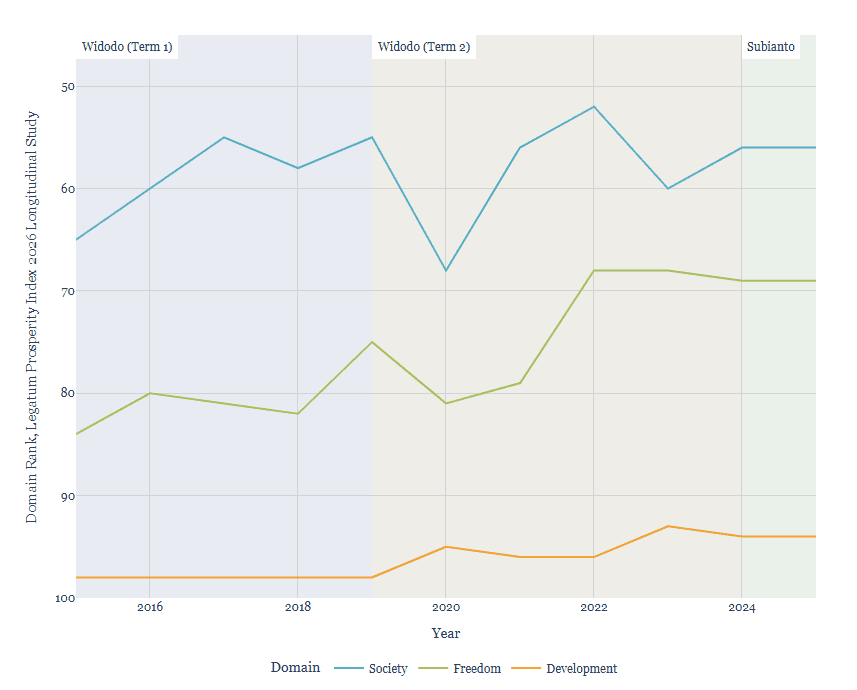
The revised Legatum Prosperity Index provides full Index scores for the years 2015-2025, and in many respects, Indonesia's performance over this period has been encouraging. Since 2015, Indonesia has gained 15 places in its overall prosperity score, rising from #79 to #64. The window roughly corresponds to the tenure of the reforming and popular former president Joko Widodo (Jokowi), the first Indonesian president not drawn from the traditional military and political elite, who was in office for two terms between October 2014 and October 2024. However, the index began showing signs of stagnation in 2023, which coincides with the democratic backsliding that began toward the end of Jokowi's last term and continues under his successor, Prabowo Subianto12.
Of the three domains in the index in Figure 1, Indonesia performs best in the Society domain. Freedom was the most improved domain over the 2015-2025 period, despite ranking lower than Society. Development seems to be the area where Indonesia faces the most challenge, being the lowest ranked with the smallest improvement. The uniform halt in the ranking's climb since 2023 serves as an early warning sign for the current administration to thoroughly review its policies in the social, political, and economic space.
Figure 1. Indonesia's ranking in the three domains of Prosperity Index (2015-2025)
Within the Index, the rise in overall rank is driven by several improvements. First, the material standard of living of Indonesia's people has increased: GNI per capita grew from USD 3390 in 2015 to 5120 in 20253, the percentage of people living on under three dollars a day fell from 22% to just under 5%4, child and infant mortality rates fell substantially, the rate of household access to improved drinking water rose from 71% to 93%5, and the rate of household access to improved sanitation rose from 62% to 85%6. These are important gains that hugely affect people's day-to-day lives, and which are reflected in Indonesia's rise in ‘Standard of Living’ from #101 in 2015 to #91 in 2025. Indonesia has also seen an encouraging rise in its Civil Peace rank from #82 to #72 over our period of study, and a reduction in inflation from 6% to 2.9%, which has seen its rank rise very substantially in the Economic Freedom pillar over the last ten years (#107 to #69).
These gains reflect a general improvement in state capacity, the subsiding of the separatist violence of the 1990's and 2000's, and arguably also the imperfect but substantial growth of a more open political process since the resignation of president Suharto in 1998 — as indicated in the development of many independent media organisations, and the separation of the police from the armed forces in 1999. Nevertheless, the stagnation in the Development domain reflects a growing economic problem faced by the country that appears most visibly in the shrinking of the middle class between 2024 and 20257. The government's response has been largely paternalistic and interventionist: expanding social assistance and supplanting private businesses with state-owned enterprises8. There are also signs that Indonesia may be forgetting the important lessons of military-civil separation from its past that may further erode its strength in the Society and Freedom domains.
This would be an unwelcome change, considering that Indonesia's greatest strength lies in its very neighbourly local communities with their optimistic and purposeful citizenry. The country ranks #4 for Integrity of Communities, up from #26 in 2015. This consistently high rank is due to excellent performance in measures such as rates of volunteering, laughter, and the helping of strangers, with its gains due to improvements in self-reported life satisfaction and hope for the future.
This data reflect a fundamental feature of Indonesian culture: the spirit of gotong royong, literally ‘lifting together’ or more commonly translated as ‘mutual aid’. To get a feeling for this concept, one should picture local villagers coming together to build a house for a community member without expecting any payment or reward. Gotong royong is the spirit of cooperation and solidarity by which a people that are still vulnerable to natural disasters and economic shocks, sustain each other during difficult times. Not for nothing did Indonesia take first place in the recent Global Flourishing Study, which attempted to measure citizens' sense of meaning and purpose in 26 countries. Yet, even gotong royong is reinterpreted by political elites as subservience to authority, rather than an egalitarian community initiative.
Controversy about statistics
Indonesia's strong communities and its long-term improvements are, however, only one side of the story. Its successes in the data have been put in the service of political rhetoric that reveals not only some long-term weaknesses, but also some particular points of concern under the new administration of former Army general Prabowo Subianto, a ruler drawn from the traditional Indonesian governing class.
First, statistics have themselves become controversial. For example, the current administration claims to have consistently met its growth target of over 5% — an important aspect of its policy platform. But experts questioned the validity of these official numbers that consistently beat market consensus since Q2 20259. The controversy peaked in Q1 2026 as Statistics Indonesia reported the highest growth rate since the pandemic despite heightened economic vulnerability and internal inconsistencies in the data10.
The government has also received criticism for its frequent references to Indonesia's success in the Global Flourishing Study. Critics point out that the study points to the purposefulness of Indonesians, but does not show that the country is the happiest on earth: on the contrary, Indonesia came only 87th in the World Poll's World Happiness Report of 2025, and this may reflect the way in which long-term problems such as corruption, narrowing space for freedom, and centralisation of power continue to affect ordinary people's lives for the worse.
Corruption
Recent events and the Index's results suggest that these concerns must be taken seriously.
First, Indonesia has ranked poorly for corruption throughout our period of study, having gained only six places from a rank of #94 in 2015 to a rank of #89 today. A particular weakness is judicial corruption, in which Indonesia has fallen from #94 to #111; it also ranks a mediocre #79 for corruption in the police and military, besides ranking #129 for state-embedded criminal actors. These results are reflected in recent events: the prosecutor and police went into a tit-for-tat battle on corruption investigations in July. Not long after the Attorney General (AG)'s office named a senior police official as a corruption suspect in the flagship Free Meals Program, the Junior AG for Special Crimes was named a corruption and money laundering suspect by the police11. His case has now been transferred to the AG's office for Special Crimes, meaning that he is under investigation by his own subordinates.
Press and civic freedom
Various press freedom organisations have also expressed concerns about the treatment of journalists within the country, fearing a return to an older, much more authoritarian form of government. Indonesia's fall of twelve places in the Index's Freedom of Dissent Pillar (from #74 in 2015 to #86 in 2025) is driven by the country's worsening performance in assessments by Reporteurs Sans Frontiers and others12, and this fall too seems to reflect the reality on the ground13. During recent anti-government protests, for example, the RSF documented fifteen attacks on journalists, including assaults by the police14. Similarly, in 2024, the journalist Rico Sempurna Pasaribu, who had been reporting on a serious gambling scandal, was murdered in an arson attack on his home together with three of his family members; and although some perpetrators were convicted, the Committee to Protect Journalists has claimed that the military investigation of a solider who was implicated in the scandal, was deeply flawed15.
Concerns have also been expressed about the recent enactment of the Electronic Information and Transaction Law, which criminalizes vague offences such as ‘violating propriety’ and ‘causing hostility’16. Meanwhile, the Prabowo administration has created a new Digital Space Monitoring Directorate General within the Ministry of Communication and Digital Affairs, led by a police Brigadier General, and has signed an agreement with several major telecom operators that expands its wire-tapping capabilities. The government says that these measures will help it to fight crime, but critics are concerned that the appointment of a police general to this role will lead the ministry to give too much weight to security as against civil rights.
In this context, it is notable that the political rhetoric around gotong royong has provided cover for the government to stigmatize dissent. Notably, this July, President Subianto spoke in public of ‘londo ireng’ or ‘Black Dutchmen’, applying the term broadly to observers (‘pengamat’), NGOs and journalists (the term originally referred to colonized people who joined the Dutch Army)17. Likewise, last year the government declared a light-hearted symbol of recent protests, the ‘Straw Hat Pirates’ Flags’, to be treasonous18.
Military involvement in politics
One trigger for recent protests in Indonesia (see next section), was the passing of new legislation that allows a greater number of military officers to serve in senior government posts, and which also expands the range of ‘operations other than war’ that the military may undertake, to include fighting perceived cyber threats. This raises the prospect of the reinvigoration of the old pre-1998 doctrine of dwifungsi, or military ‘dual function’, by which the armed forces are permitted to become involved in political affairs19. Legal experts complain that the government failed in its duty to publish a draft of this law when it was under debate20, showing the lack of transparency of this important legislative change.
Protests
Mention has already been made of anti-government protests. Large-scale protests have been ongoing since last February, motivated by a range of concerns: government cuts, unemployment, corruption in the police, and the aforementioned changes to laws relating to military involvement in politics. Although these protests have generally not been suppressed by force, the police response has led to at least one fatality. They also reflect growing dissatisfaction with the current regime, with the president's approval rating having fallen from over 80% in November 2025 to 51% in July of this year21. The future of the regime remains uncertain — as does its response to this serious challenge.
Conclusion
Despite these serious concerns — corruption, the stigmatization of dissent, a regrowth of military involvement in politics, and public dissatisfaction — it remains the case that Indonesia is far wealthier and freer than it was before the beginning of the Reform Era in 1998. Fundamental indicators such as GDP and the rate of destitution continue to be encouraging, and Indonesian civil society remains strong, with robust civil society organisations and a broadly based and free media. Moreover, the people continue to show a willingness and ability to engage in the political process, and to make their dissatisfactions very clear.
Nevertheless, as a new administration settles in, there are warning signs that the Indonesian state may be beginning to forget some of the lessons learned in recent decades. Amid shrinking space for freedom and development, the society must defend gotong royong's true spirit of community-led initiatives, rather than allowing the tradition to be repurposed as blind obedience. Indonesia welcomes its 81st birthday as a fairly prosperous country: #64 out of 161 on our Index. But climbing further would be challenging if the administration continues to prioritise control and opaqueness over freedom and transparency.
- Martin Petlach & Veronica Říčanová, From people's champion to power consolidator: examining Jokowi's role in Indonesia's democratic backsliding, Policy Studies, 2025. Link available here.
- Kate Lamb & Ben Doherty, Prabowo's Indonesia, the military is quietly creeping back into civilian life, The Guardian, 2025. Link available here.
- World Bank, GNI per capita, Atlas method (current US$) – Indonesia. Link available here.
- World Bank, Poverty headcount ratio at $3.00 a day (2021 PPP) (% of population) – Indonesia. Link available here.
- Statistics Indonesia, Percentage of Household with Access to Improved Drinking Water Source by Province and Urban Rural Classification (Percent). Link available here.
- Statistics Indonesia, Proportion of Households Using Improved Sanitation Services by Urban-Rural Classification (Percent). Link available here.
- Wisnu Setiadi Nugroho, The Shrinking Middle Class, The Slowing Engine of Social Mobility, Faculty Insight, Universitas Gadjah Mada web site, 2026. Link available here.
- Rae Wee, Karin Strohecker and Marc Jones, Prabowo's populist policies propel a ‘doom-loop’ in Indonesian markets, Reuters, 2026. Link available here.
- Dimas Waraditya Nugraha, The Paradox of 5.12 Percent Economic Growth, Kompas, 2025. Link available here.
- Mohamad Ikhsan and Teuku Riefky, Indonesia GDP Growth — First Quarter 2026: Behind the 5.61% Headline, Universitas Indonesia Institute for Economic and Social Research, Special Report, May 2026. Link available here.
- Ary Hermawan, Police vs prosecutors? Indonesia's latest corruption scandal exposes elite fracturing under Prabowo, Indonesia at Melbourne, University of Melbourne web site, 2026. Link available here.
- Putri Laksmi Nurul Suci, Dear Editors: Freedom of the Press in Indonesia, Kompas, 2025. Link available here.
- Civicus Monitor, Indonesia: Civic space regresses with targeting of activists, brutal crackdown on protests and problematic law revisions. Link available here.
- Reporters Without Borders, Indonesia: RSF urges President Prabowo to protect journalists amid nationwide protests | RSF, 2025. Link available here.
- Committee to Protect Journalists, Impunity in Indonesia: The leads left unfollowed in journalist Rico Sempurna Pasaribu's murder, 2026. Link available here.
- Kurniawan Arif Maspul, Reversing the Decline of Press Freedom in Indonesia, Geopolitical Monitor, 2025. Link available here.
- Yerica Lai, Prabowo calls some journalists, critics ‘londo ireng’, The Jakarta Post, 2026. Link available here.
- Alberto Zambrano, Indonesian Government Declares One Piece Flag a Symbol of Treason, Otakukart, 2025. Link available here.
- Abdil Mughis Mudhoffir and Rafiqa Qurrata Ayun, The new TNI Law is about much more than just military dual function, Indonesia at Melbourne, University of Melbourne web site, 2025. Link available here.
- Indonesia at Melbourne Editorial Team, Why the new TNI Law is legally flawed: critical notes from PSHK, Indonesia at Melbourne, University of Melbourne web site, 2025. Link available here.
- Ajeng Dinar Ulfiana, Indonesia's Prabowo approval rating drops to 51.1%, survey finds, Reuters, 2026. Link available here.

